Whole House Dehumidifier
There are all sorts of reasons why you might need a whole house dehumidifier, regardless it it's winter or summer.
Condensation
Dehumidifiers can be used to control condensation on windows, walls and ceilings that would otherwise make its way down to the wooden frame of the house and cause rot.
Traditional ways to control condensation include a technique which is known in Germany as "Stoffluften" and in North America as "House Burping". It's the act of throwing all the windows in the house open in the middle of the winter to vent all the damp air out of the house. Cold air rushes in, the windows are closed again, and the heating system warms the air back up usually to a humidity level that was lower than before.
Stoffluften or house burping works because ventilation is an important factor in humidity. If you have old windows that leak air badly around the frames the windows may not fog up. You can also make inside ventilation by having a fan blow air up from the floor across the windows and stop the humid air from condensing on the gas to some extent.
Indoor Humidity
Dry air feels cooler and allows you to turn the temperature down. In general the ability of air to hold water decreases as temperature decreases. At high temperatures you can pack a lot of water into the air.
At near freezing temperatures, the air can hold very little water so dehumidification is not effective no matter how big the machine.
Preventing dampness
Preventing dampness is a huge deal in crawlspaces on some parts of the world. Dampness in bathrooms is another. The most common evidence of dampness we all see is the condensation that forms on the inside of windows.
This is at it's worst when there is only a single pane of glass between the cold outside winter weather and the warm inside temperature. The single sheet of glass has almost no insulating value, so heat travels through it depositing moisture on the inside of the glass as long as the inside air has humidity it can release.
There are ideas about how to get rid of this moisture such as this window squeegee vacuum that attempts to wipe it off and collect the water. But of course so long as the inside air is humid the water is boing to come right back. Sometimes in only a matter of minutes.
Mould growth
Getting rid of humid air is more than just eliminating water on the inside of windows and on walls. Humid air is the perfect medium for mould growth which causes serious health problems such as asthma. Dehumidifiers can keep relative humidity from exceeding 50% which is the baseline for mould growth. That's the point at which dampness starts to deposit on interior walls, ceilings, floors and windows.
Dryer air also reduces the tendency for building materials to off gas, or release volatile organic compounds into the interior airspace. If that dampness remains for any length of time, mould spores and start to grow in it.
The longer the walls remain damp, the deeper the mould penetrates until the wall material, the wood framing beyond all start to rot. Dehumidification slows down the process of wood rot, keeping the wood structure inside your walls stable.
Overly Dry Air
When air is less than 30% relative humidity it can be uncomfortable, your feet generate static electricity. Your nose bleeds frequently
They can help your furnace
It's cheaper to dehumidify air than to heat it. This is particularly true in countries like the UK where heating energy costs are sky high. In England you can pay $0.50 -$1.00 USD per kilowatt hour for electricity. At the same time the UK has always been known a very damp country.
So if you can reduce the humidity in your rooms at home without changing the temperature it's going to cost you less money to feel comfortable. Turning the heaters or furnace on to affect the temperature will be much more costly. Furnaces and heaters use 10 to 15 times the energy that a dehumidifier would when they are running.
In very general terms efficient refrigerant style dehumidifiers need 2000 BTU or British Thermal Units of energy to take 1 liter of water out of the air. Or 1000 BTU to remove 1 pint of water. The smaller dessicant style units are less efficient but still dont use anywhere near the energy a typical heater or furnace uses during the colder winter months.
1000 BTU translates to 293 Watts of electricity usage. Even a simple electric baseboard heater can use 1200 Watts. A central heating furnace or electric radiator system heating an entire house or apartment can use 10,000 Watts or more.
Whole house dehumidifier ratings
Dehumidifiers are rated based on graphs established by engineering standards organizations. For any volume of air contained in a bathroom, a basement, a whole house or even a huge warehouse there is a specific amount of moisture contained in that volume of air based on standardized temperatures and measures of relative humidity.
The air volumes, temperatures and relative humidity always have to be the same so you can compare one dehumidifier against another. Those temperatures and relative humidity are always higher than any room in your house would ever be because they want to show the maximum amount of water that could be extracted from that air.
What water the specific dehumidifier can actually extract will always always be less because no one could live in a house that had 30 deg C or 86 deg F air at 90% relative humidity. This video below shows how awful that actually is.
To rate dehumidifiers I rate them according to how much water they can remove from the air from highest to lowest. The biggest units are usually refrigerant style. Think big and heavy like a window air conditioner. There actually is very little difference between air conditioners and refrigerant dehumidifiers.
Next down the list are the desiccant and Peltier device dehumidifiers. These are typically smaller capacity when made for home use. Yes I know there are giant dessicant dehumidifiers used in swimming pools and ice skating rinks. But for home use they allow the manufacturer to create a lightweight small package unit that might be best removing the humidity from a single room.
The size of dehumidifier you need depends on the volume of air you need to dehumidifier. If you just have condensation on the walls and windows in your bath room, you first need to find the total volume of air in that room. Length times width time height.
The same calculation applies to any room in your house. I does not matter if its a bathroom, living room bedroom or basement area. If the whole house has humidity problems, you are going to to have to add all the room air volumes together.
Indoor clothes drying with a dehumidifier
You might have a more basic problem like the humidity created from drying clothes on a clothes rack indoors in the winter. Damp clothes hanging on a clothes rack or an indoor clothes line have quite a lot of water in them. Ask anyone who has had a wash line fall down or a clothes rack collapse!
You need to be able to size a dehumidifier that can remove as much water as your washing machine puts into the wash.
Most washing machines use 40 to 80 liters of water per load depending on the age and size of the washing machine. More than half of that water gets flushed down the drain as dirty water during the spin cycle. About 20 to 40 liters remains to be dried out in your clothes. So you need a dehumidifier capable of removing 20 to 40 liters per day to get rid of that water.
If you want to really know for sure how much water you are dealing with, measure the weight of your wash load of clothes before they go into the washing machine by weighing them on a bathroom scale preferably in kilograms. Then measure the weight after they come out. Subtract the weight before they went in from the weight after, then you have the weight of water you have to remove from the clothes.
This is where the metric system really makes life easy! One liter of water weighs one kilogram, so if you know the weight of water in kilograms remianing in your clothes after the wash cycle you know how many liters per day your dehumidifier will have to remove.
 |
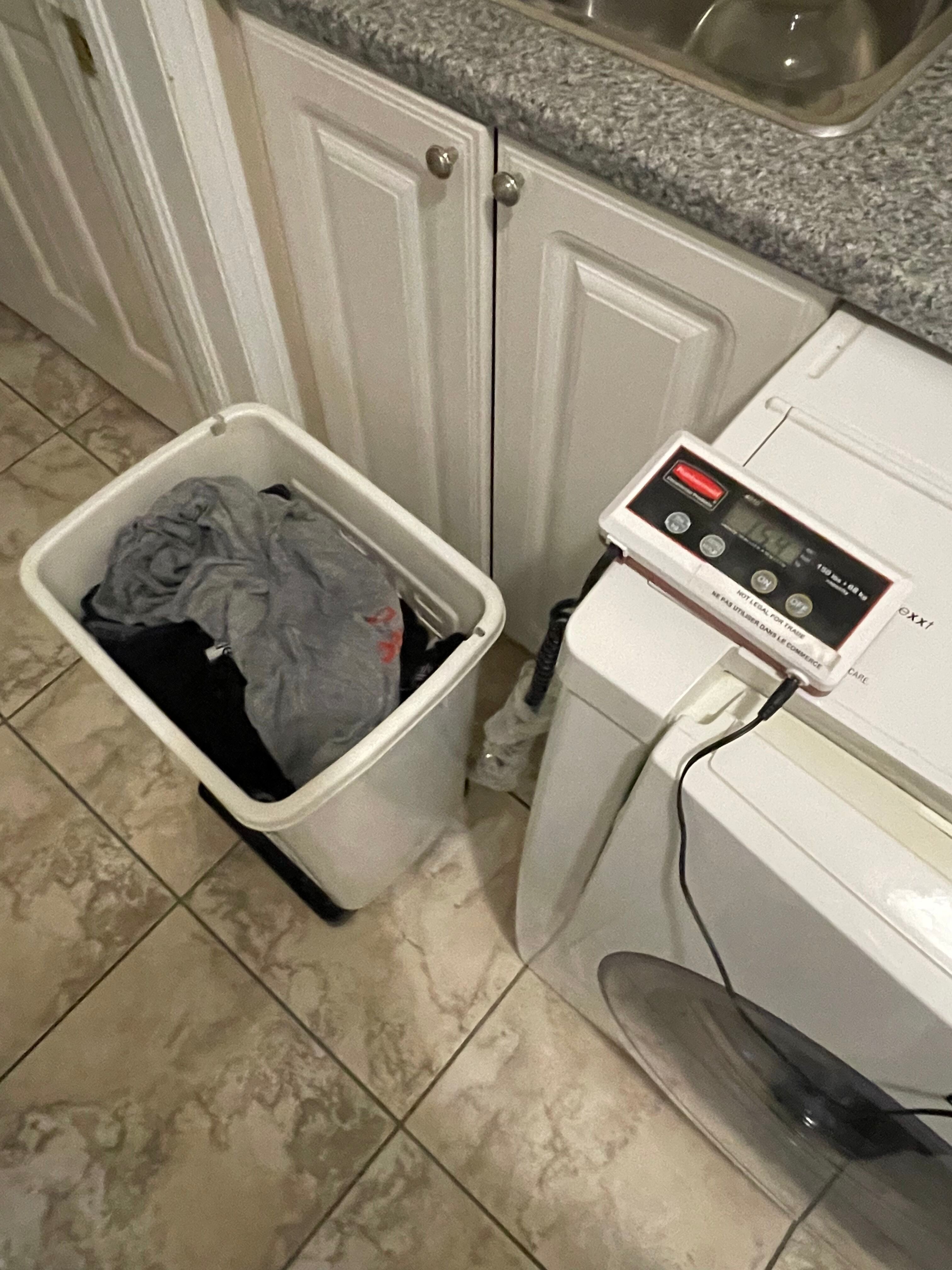 |
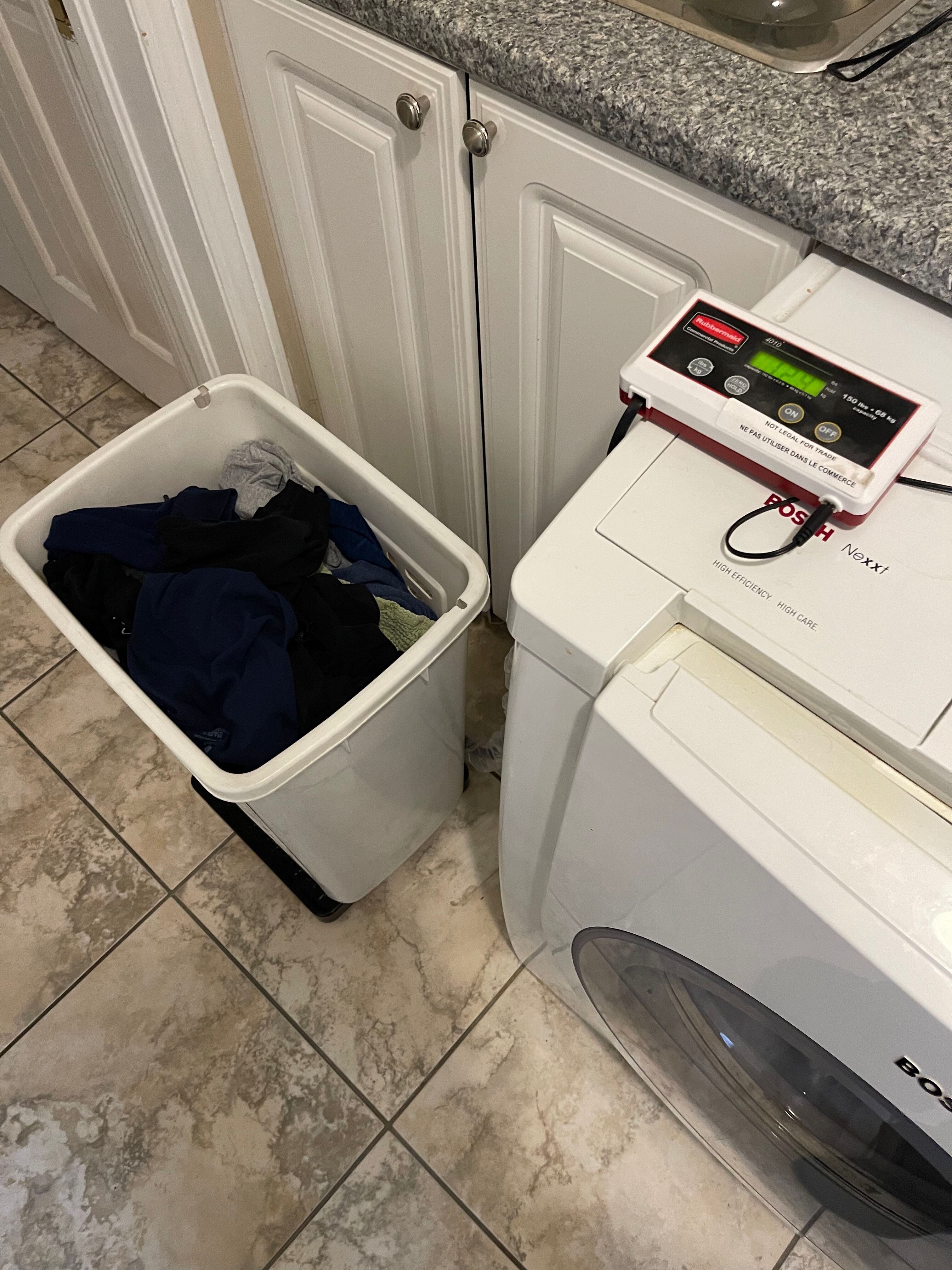
In the pictures above I have measured the weight of this relatively small one person washload before and after drying in the clothes dryer. It's 15.4 lbs after it comes out of the washing machine and 12.4 lbs after it comes out of the dryer. So 3 lbs of water was removed by the clothes dryer. If I was to use a dehumidifier instead of the clothes drier I would need one that could remove 1.36 liters of water in a 24 hour period. Any unit rated at 5-10 liters per day would work fine.
Here are some more resources related to drying laundry with a dehumidifier
How to position your dehumidifier
The best advice is to put your dehumidifier where the damp is and give it a few feet all around so the damp air can circulate into the unit and the dry air can blow out.
This article talks about putting your machine facing an easterly wall since it's likely to be the most damp wall in your house. Easterly walls apparently don't get a lot of sun.
But there are many reasons why any wall, ceiling or floor could get damp so locate the damp place in your home to guide the placement of the dehumidifier.
Dehumidifier risks
Dehumidifiers are electrical devices operating with high voltages and therefore there is always a risk of component malfunction under extreme situations leading to fire. In most cases the compressor used in a larger refrigerant style dehumidifier overheats and sets the plastic housing of the dehumidifier alight.
Dehumidifiers use CSA and UL certified fire resistant plastic but manufacturers have been caught using bogus approval stickers and non fire rated plastic housing materials.
Another concern is when electrical extensions cords are used with wire that cannot carry the rated current for the dehumidifier. Excessive cord lengthis also a factor. You dont want extension cords heating up and melting potentially causing a fire.
The USA Consumer Product Safety Commission publishes a list of manufacturers and model numbers that have been subject to product recalls that in some cases have been due to dehumidifiers causing fires.
https://www.cpsc.gov/Recall-Products/Dehumidifiers
More information
Here are the resources used in putting together this page
- Using a dehumidifier in the winter
- Dehumidifier used to get rid of mould
- Clothes drying with a dehumidifier
- The costs of making air drier
- Why do modern homes haved mould problems ?